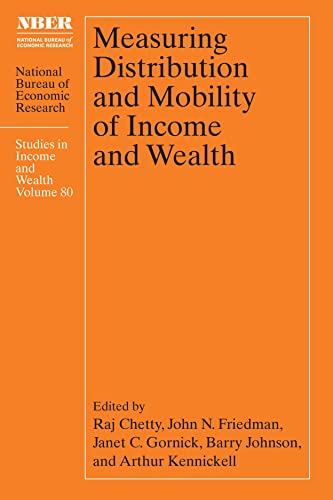
Measuring distribution and mobility of income and wealth :
Material type: TextSeries: Studies in income and wealth ; . 802104Publisher: Chicago: The University of Chicago Press, 2022Description: xiii, 721 pages : illustratuins ; 24cmContent type:
 - text
- unmediated
- volume
- 9780226816036
- HC79.I5.M37
- BUS021000 | BUS069000
Revised versions of papers presented at the Conference on Research in income and Wealth titled "Measuring and understanding the distribution and intra/inter-generational mubility of income and wealth", held in Bethesda, Maryland, on March 5-6, 2020.
Includes bibliographical references and index.
Introduction: In search of the roots of American inequality exceptionalism : an analysis based on Luxembourg Income Study (LIS) data / Rising between-firm inequality and declining labor market fluidity : evidence of a changing job ladder tUnited States earnings dynamics : inequality, mobility, and volatility tEvidence from unique Swiss tax data on the composition and joint distribution of income and wealth tThe wealth of generations, with special attention to the Millennials r tWealth transfers and net wealth at death : evidence from the Italian inheritance tax records, 1995-2016 tOn the distribution of estates and the distribution fo wealth : evidence from the dead tStructuring the analysis of wealth inequality using the functions of wealth : a class-based approach tSocial security wealth, inequality, and life-cycle saving tParental education and the rising transmission of income between generations tInequality of opportunity for income in Denmark and the United States : a comparison based on administrative data tPresence and persistence of poverty in US tax data tIntergenerational home ownership in France over the twentieth century tInequality and mobility over the past half-century using income, consumption, and wealth tThe accuracy of tax imputations : estimating tax liabilities and credits using linked survey and administrative data tGeographic inequality in social provision : variation across the US states tInequality and the safety net in American cities through the income distribution, 1929-1940 tThe EITC and linking data for examining multigenerational effects tDistributing personal income : trends over time tDeveloping indicators of inequality and poverty consistent with national accounts tDistributional national accounts : a macro-micro approach to inequality in Germany tThe distributional financial accounts of the United States tUsing tax data to better capture top incomes in official UK income inequality statistics.
"A collection of twenty-three studies that explore the latest developments in the analysis of income and wealth distribution and mobility. Economic research is increasingly focused on inequality in the distribution of personal resources and outcomes. One aspect of inequality is mobility: are individuals locked into their respective places in this distribution? To what extent do circumstances change, either over the lifecycle or across generations? Research not only measures inequality and mobility, but also analyzes the historical, economic, and social determinants of these outcomes and the effect of public policies. This volume explores the latest developments in the analysis of income and wealth distribution and mobility. The collection of twenty-three studies is divided into five sections. The first examines observed patterns of income inequality and shifts in the distribution of earnings and in other factors that contribute to it. The next examines wealth inequality, including a substantial discussion of the difficulties of defining and measuring wealth. The third section presents new evidence on the intergenerational transmission of inequality and the mechanisms that underlie it. The next section considers the impact of various policy interventions that are directed at reducing inequality. The final section addresses the challenges of combining household-level data, potentially from multiple sources such as surveys and administrative records, and aggregate data to study inequality, and explores ways to make survey data more comparable with national income accounts data. "-- Provided by publisher.
There are no comments on this title.